

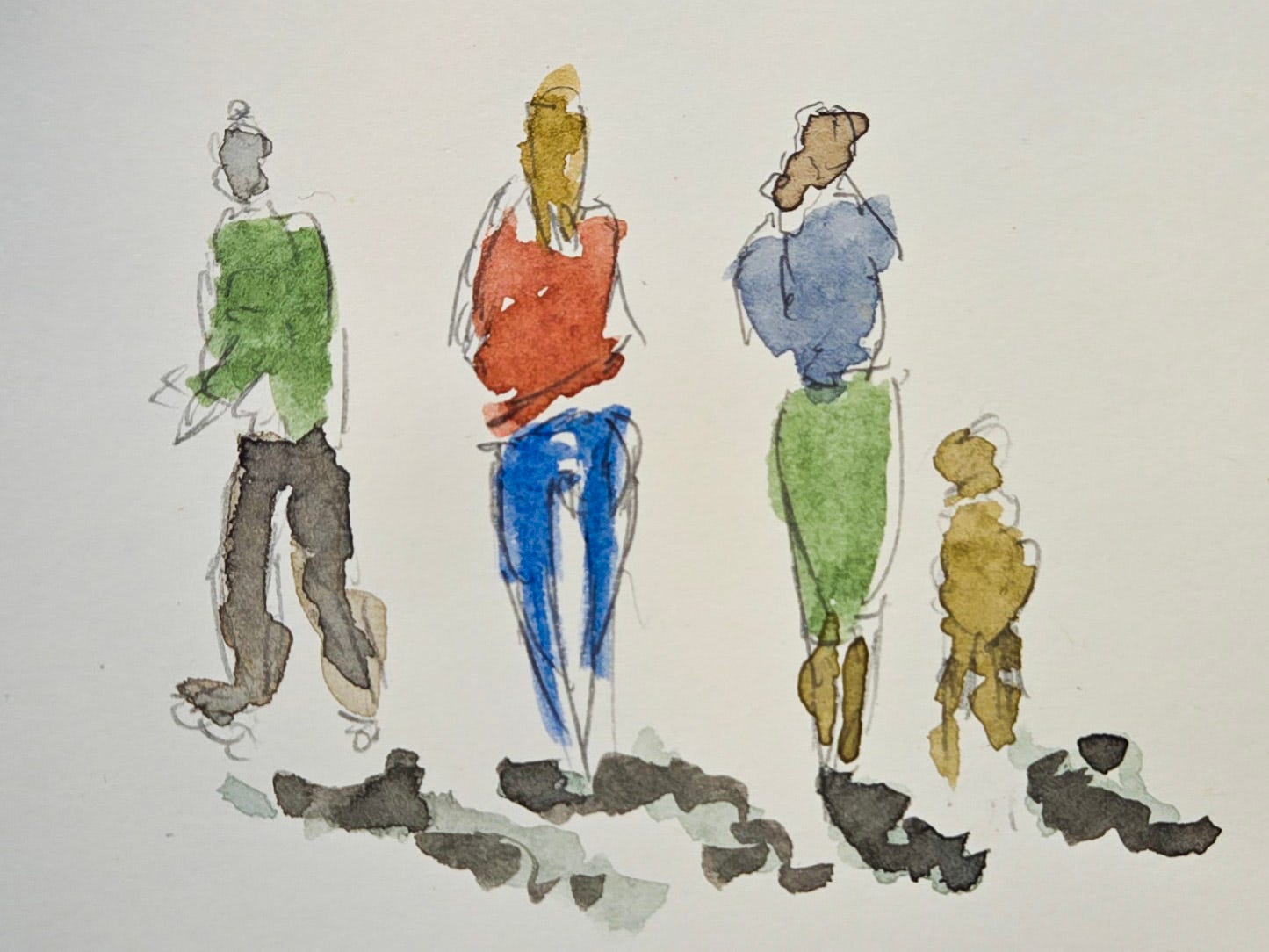
Most of us know the pattern. We want to work on the project, work out, write, paint, exercise, start the project, make the call, or finally begin something we’ve been putting off. But we don’t feel motivated, so we wait. We tell ourselves we’ll start when we feel more inspired, energetic, confident, creative, or certain.
Then another day disappears.
The problem may not be a lack of motivation. It could be our belief that motivation has to come first.
It often doesn’t.
My motivation rises and falls with mood, energy, sleep, stress, fear, and whatever else life throws at me. The same is true for all of us once we become aware. If we require ourselves to feel motivated before beginning, we give our emotions veto power over our intentions.
Knowing that, sometimes the fastest way around that problem is to make the first step so small there is almost nothing left to resist.
A watercolor teacher I recently watched described this beautifully. Don’t tell yourself you have to paint a picture. Fill the water jar. Put the brushes on the table. Mix one color. Make one mark.
The objective is not to finish
It is to begin. As with the watercolor figures you see above, I meet resistance all the time when learning to paint. To get out of my own way, I had to learn these psychological and spiritual principles that empower us to shift into a higher dimension of well-being.
For me and all other artists, it’s the flow state that compels us. But finding that state of mind and being requires understanding the human mind and our behavior.
Psychology supports the idea that action can come before motivation. Behavioral activation, a well-established psychological approach, encourages people to take meaningful action rather than waiting for their emotional state to improve first.
Action creates opportunities for satisfaction, accomplishment, and momentum. In other words, we sometimes act our way into motivation rather than waiting for motivation to move us.
This also helps explain procrastination
We tend to think procrastination means we are lazy, undisciplined, or poor at managing time. But psychologist Fuschia Sirois has spent years studying procrastination and describes it largely as an emotion-regulation problem. We often avoid a task because of the feelings attached to it.
We may fear failure, criticism, embarrassment, boredom, or discovering that we aren’t as good as we hoped.
We cannot reject the unfinished article. The unpainted picture cannot disappoint us. The business we never launch cannot fail.
Avoidance gives us temporary relief, and therein lies the trap. Tomorrow, the blank page is still waiting.
The answer may not be more discipline. It may be approaching the task differently.
Zen Buddhism offers a wonderful concept called shoshin, or beginner’s mind. Zen teacher Shunryu Suzuki famously wrote in Zen Mind, Beginner’s Mind, “In the beginner’s mind there are many possibilities, but in the expert’s there are few.”
The beginner has less to protect.
A beginner experiments, asks questions, makes mistakes, changes direction, and tries again. A beginner does not expect mastery on the first attempt. That freedom becomes harder to maintain as we accumulate knowledge, titles, accomplishments, possessions, expertise, and identities. Eventually, we can become so invested in protecting who we have become that we stop experimenting with who we might still become.
Beginner’s mind does not ask us to become ignorant
It asks us to remain open.
Henri Matisse understood this. In his writing about art, he emphasized the importance of learning to see things as though we were seeing them for the first time. He believed the artist had to preserve something of the child’s vision of the world.
Perhaps we all do.
Jesus offered a remarkably similar image from an entirely different spiritual tradition. In Matthew 18:3, he tells his followers they must “turn and become like children.” In Mark, he says the Kingdom of God must be received like a little child.
I don’t read that as an invitation to childishness. I hear an invitation to humility, openness, curiosity, trust, and wonder.
Watch a small child create, such as one of my grandchildren, and you see it immediately. Children rarely stare at a blank piece of paper worrying whether the finished drawing will be impressive. They draw. They make green dogs, purple suns, crooked houses, and people with arms growing out of their heads.
Then they proudly hand you the masterpiece.
Somewhere along the way, many of us learn to judge the work before we make it.
That may be one of creativity’s great enemies.
Taoism offers another useful idea: wu wei, commonly translated as “non-action,” though the Stanford Encyclopedia of Philosophy describes a richer philosophy of acting without unnecessary striving or force.
Think about water meeting a rock
Water does not argue with the rock. It does not procrastinate because the obstacle seems unfair. It finds an opening and keeps moving.
Maybe that is what we need when we feel stuck.
Instead of conquering the entire mountain, take the next natural step. Write one paragraph. Walk ten minutes. Make one phone call. Sketch one hand. Read one page. Fill the water jar.
Movement changes something.
We tend to imagine inspiration arriving like lightning. Sometimes it does. More often, it arrives quietly as curiosity. A thought. A question. A photograph we want to take. A sentence that keeps returning. A faint inner voice saying, Try this.
Our mistake may be waiting for that whisper to become a roar.
It may never happen.
Inspiration can open the door. Action carries us through it. Motivation often catches up after we have already begun.
I’ve been a beginner artist since June 1961, which is another way of saying I’ve been learning since the day I arrived here. I hope I never graduate.
Maybe that is the larger lesson for all of us.
Remain teachable. Be incessantly curious. Expect imperfect beginnings. And when you catch yourself waiting to feel motivated, make the next step ridiculously small.
Then take it. And have fun as you did as a child.
Thanks for commenting and restacking this article if it helped.