


Retirement is against my constitution, but I’m at retirement age. That means I no longer work for money as much as for meaning, something I discovered when I was only thirty. My wife and I live a modest life with reasonable wants, needs, and means. That allows me to choose work that pays more than money.
It also lets me do whatever I want with my time. For example, a recent outdoor adventure with my son and grandson to a new national park: Chiricahua National Park in Southern Arizona.
That time is priceless and rich with meaning.
Knowledge work defined
Before I give you two examples of remote work that pays well, let me define knowledge work. Management thinker Peter Drucker popularized the term “knowledge worker” in 1959. Simply put, knowledge workers earn a living by applying what they know rather than primarily performing physical labor.
We get paid to think, analyze, create, solve problems, make decisions, and help others do the same. Examples include writers, consultants, accountants, software developers, researchers, educators, and coaches. The beauty of knowledge work in today’s digital economy is that much of it can be done from virtually anywhere.
Your accumulated knowledge, experience, and expertise become assets you can monetize without necessarily having a traditional job.
High-paying knowledge work examples
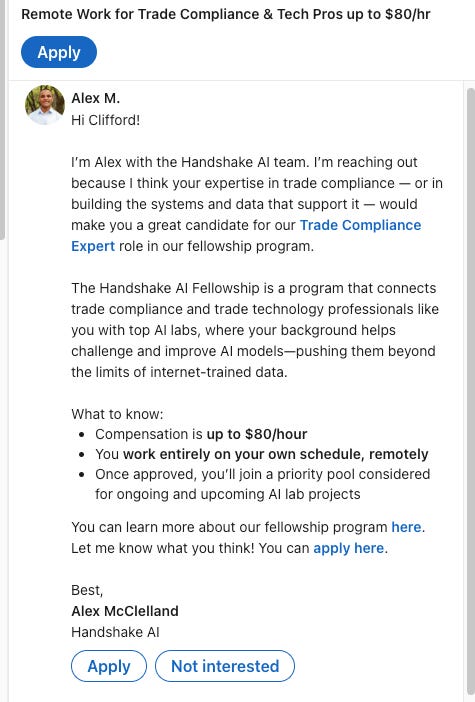
Here’s an example of work that I refuse to do even though it pays $80 an hour, and often more, depending on what you know. One reason is that I don’t want anyone or any organization monitoring my computer activity.
Some companies that hire people to train AI require time-tracking and activity-monitoring software as a condition of the work. It’s not for me.
Screenshot by author.
The second example is a company that prominently promotes these jobs on LinkedIn. Founded in 2023, Mercor is an AI training company that recruits experienced professionals through LinkedIn and other platforms.
Its business model is simple: pay people to teach artificial intelligence what they know. Independent contractors use their professional knowledge and experience to train AI models, evaluate responses, and improve AI system accuracy.
Screenshot by author.
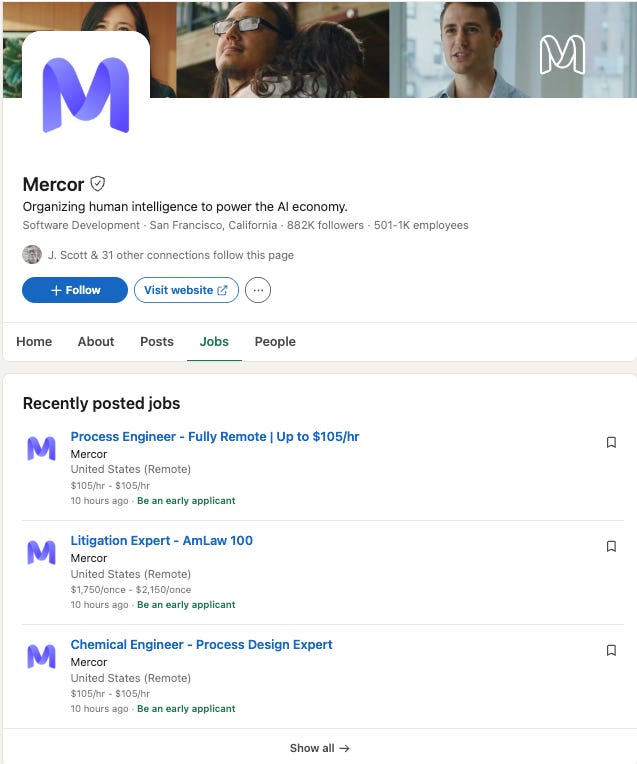
Some of these remote work opportunities pay $50 to $200 or more per hour, depending on the expertise required. However, neither work volume nor income is guaranteed. To explore these opportunities, do a simple online search for “remote jobs training AI.”
According to Mercor’s own guide to AI trainer compensation, expert-level work can pay between $75 and $200 an hour, sometimes more.
I have no problem with people who choose to do this work
Many people do this kind of work out of financial necessity, and I respect that. But if you are a knowledge worker fueled by curiosity and a desire to make money, whether you work remotely or not, challenge yourself to be creative enough to find other ways to earn.
For me, it’s writing, selling photography and my watercolor paintings, and mentoring and coaching. I am fortunate that I faced the fear that keeps many of us from prioritizing meaning in our work over money. I faced it deliberately when I was thirty, a father of two young sons, and married to my college girlfriend.
The quest for meaning never ends
What gives our lives meaning at thirty may be quite different from what gives our lives meaning at sixty-five. The beauty of growing older is that we can draw on a lifetime of knowledge and experience to discover new ways to express ourselves, serve others, and contribute meaningfully to the world.
“For the meaning of life differs from man to man, from day to day and from hour to hour.” — Viktor Frankl, Man’s Search for Meaning
I am blessed to have found meaning in my work early on. If you’re still searching, keep going. Never give up on yourself. You are a unique soul, and you are here for reasons you may or may not know.
My wife wanted to raise our boys instead of jumping into the rat race with me. I wanted to be home every night with my family. Those values drove much of my decision-making about work and money from that point forward.
Did it all work out according to plan? Hardly. We experienced some devastating financial setbacks along the way. But those experiences taught me to become more resourceful, creative, and resilient.
They also taught me how little money we need to be genuinely happy compared to what we are conditioned to believe we need. Because of that, we now have fewer wants, which, in and of itself, is a form of wealth.
What are you worth?
There’s nothing wrong with earning $80 an hour or more training artificial intelligence. Had I been presented with such an opportunity at certain points in my life, I probably would have jumped at it. But at this stage of my life, I would rather earn less doing something I love than earn more doing something that means little to me.
Just know there’s a difference between what you know and what you are worth. If you have experience, you have unique knowledge. What you are worth depends on the market you are in and how much value you put in yourself.
Ultimately, our worth comes down to our confidence. When I write a story, paint a picture, or mentor someone struggling to find their way in life, I get compensated in ways that have nothing to do with money. I get to exercise my curiosity, express my creativity, connect with other human beings, and hopefully contribute something of value to their lives.
I value myself, but it took a lifetime to figure that out.
And nobody monitors my keystrokes
The challenge for many of us, especially as we approach retirement, is to rethink our relationship with work. What do we know? What do we love doing? Who could benefit from what we know? How might we earn money doing more of what we love?
Perhaps the most important question is this: How would you choose to spend your remaining working years if money were not your primary concern?
Your answer might reveal more about the work you were meant to do than any job posting on LinkedIn. But the truth will be revealed the more you know yourself.
Feeling stuck? Check out my simple process to shift.