

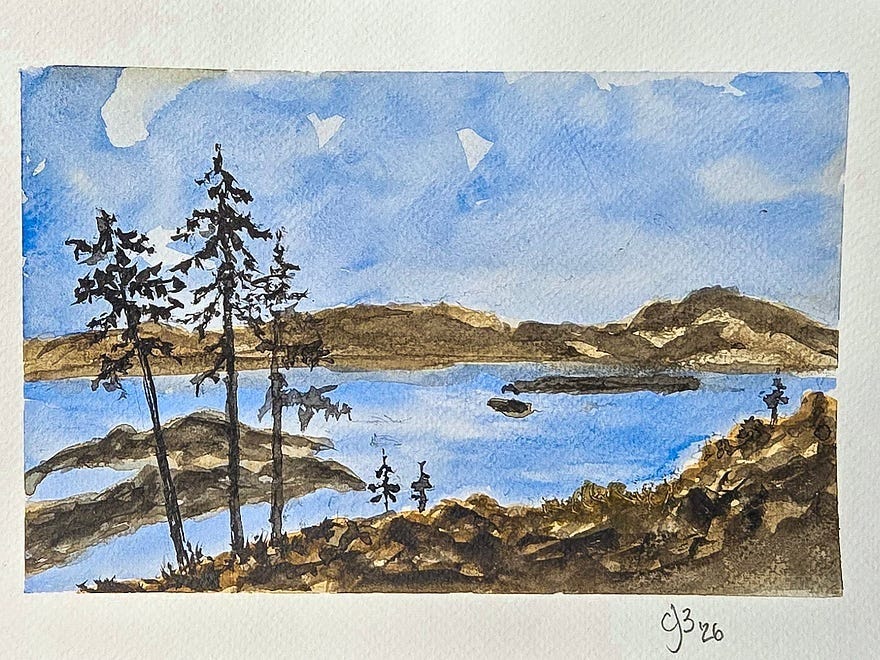
I spent more than a decade as a financial consultant helping people prepare for retirement. I knew a thing or two about investments, building wealth, managing risk, and creating a reliable retirement income. What I didn’t know, and couldn’t possibly have known at the time, was how little I understood about the psychology of retirement.
Now, at 65, I’m getting an education I never expected. That includes learning to paint and write better.
Admiration, not envy
I admire my wife and some of my best friends because they chose a single career and industry. Through all the ups and downs of the economy and their lives, they stuck it out and became masters of their domains. They’ve earned the reputations, professional standing, and financial rewards that come with decades of dedication.
Admiration is different from envy. As a decent wordsmith, I’m careful about the words I use, and those I don’t. My path was that of a creative, outlying misfit who needed to prove he could become a successful entrepreneur. I navigated it with unrealistic optimism, too little realism, and a stubborn determination to succeed. A part of me looks back and says, “Dude, did you really need to prove all that, and if so, to whom?”
Over several decades, I founded and built small businesses that provided a moderate income and an extraordinary amount of freedom over my time, something many people spend their entire careers dreaming about. So my tradeoff was being rich with time, making a decent income, and choosing work that fired me up until it didn’t.
All of that to say, the people I admire still have their thing. I don’t. My thing gradually left me over the past few years. Learning to let go is a huge part of the art of life.
What happens when ambition disappears?
For decades, I made my living as a business consultant, executive coach, writer, and nonprofit board facilitator. I loved the intellectual challenges, helping others solve problems, and the satisfaction of making a difference. I also enjoyed making money.
But somewhere along the way, I lost my desire to promote myself, pursue new clients, and build another business. The ambition that had driven me since my twenties faded.
I still earn some money writing, mentoring, coaching, and selling my artwork. But I no longer feel compelled to hustle, market myself, or turn every creative pursuit into another commercial venture.
You might think this newfound freedom would be wonderful. And much of it is. But it also comes with an unexpected psychological challenge. Who am I without the work that defined me? What do I do with all this freedom? And why do I occasionally feel guilty when I’m doing absolutely nothing?
The philosopher Bertrand Russell recognized this problem nearly a century ago. In his 1932 essay, In Praise of Idleness, he observed that people accustomed to working long hours can become bored when suddenly confronted with leisure.
I’ve discovered there’s an enormous difference between having time freedom and knowing how to enjoy it.
The retirement void
As I sat down to write this article, I had a warning I wish someone had given me years ago.
Don’t rush to retire, especially if you enjoy your work. If not, invest your time finding work you can do for a long time. That will take a lot of pressure off the compulsion to “stop working.” That’s because retirement may not be what the marketing machine makes it out to be. Even if you have all the money in the world, you may struggle when the work, responsibilities, and professional identity that gave your life structure suddenly disappear.
A 2025 review published in The Gerontologist examined 30 studies exploring meaning during the transition to retirement. Researchers found that leaving work can challenge our sense of identity, purpose, and significance. While many people adjust well, others find the transition surprisingly difficult.
One of these difficulties has a name: purpose anxiety, a term introduced in 2014 by Larissa Rainey, a researcher at the University of Pennsylvania. It describes the emotional distress we sometimes experience while searching for meaning and direction in life. This anxiety can become especially pronounced during retirement, when the careers, responsibilities, and identities that once gave our lives structure begin to fade.
The Danish philosopher Søren Kierkegaard famously associated anxiety with the dizziness of freedom. I think he was onto something. We spend our working lives pursuing freedom, only to become anxious when we finally have it.
I refuse to let this dizziness turn into vertigo.
What if we don’t need another purpose?
I’ve had plenty of practice dealing with my own head trash over the years. I’ve also become increasingly interested in the difference between having a purpose and living a meaningful life.
Purpose often suggests having a goal, something to accomplish or a destination to reach. Meaning can come from something much simpler: loving another person, creating something beautiful, enjoying nature, helping someone in need, or spending an afternoon doing absolutely nothing.
Perhaps one of retirement’s greatest opportunities is learning to stop adding and begin subtracting. Less striving, comparing, and worrying about what other people think. More curiosity, generosity, contemplation, exercise, creative expression, and time with those we love.
I’m not suggesting we abandon ambition or become aimless. I’m suggesting we become more intentional about how and where we invest our remaining time. Not everything we do needs to produce a measurable result, earn a dollar, or impress somebody.
After a lifetime of pursuing goals, I’m discovering that this requires a different kind of discipline. It’s one thing to have the financial freedom to choose how to spend your days. It’s quite another to free yourself from the belief that you must accomplish something worthwhile every day.
Learning to live without having something to prove
I spent years helping people develop retirement financial plans, build a business, and create wealth. Today, I’m discovering how important it is to prepare for the psychological transition, too.
After all, how much is peace of mind and a great night’s sleep worth? Perhaps these things are worth all the money in the world, considering many very rich people have neither.
I’m learning to recognize my own purpose anxiety, question the expectations I’ve carried for decades, and become more intentional about how I invest my time. Some days are easier than others. After a lifetime of striving, the desire to accomplish something doesn’t disappear simply because the desire to make more money has faded.
Of course, we need enough money to live the lives we desire, within reason. Financial security matters, especially as we grow older. But one unexpected benefit of aging may be discovering that we don’t need or want as much as we once thought. With a little wisdom, we begin to distinguish between what genuinely enriches our lives and what we’ve spent decades pursuing out of habit, ambition, or the desire to impress others.
I’m finding that the things that matter most at this stage of life have surprisingly little to do with money. Good health, people I love, meaningful relationships, creative expression, curiosity, and the freedom to spend my time as I choose. I can write because I love writing, make art because I enjoy creating, and ride my bicycle because I love being outdoors, without having to justify any of it.
Perhaps retirement requires more than financial independence. It requires learning what enough looks like, letting go of unnecessary wants, and developing the psychological freedom to enjoy life without constantly measuring what we’ve accomplished.
And perhaps that’s the most important lesson I never learned during all those years helping other people retire.
We need to earn enough to live. But we don’t need to spend the rest of our lives proving we’ve earned the right to enjoy being alive.
For most of life in our culture, purpose has been self-referential: career, family, acquisitions. Shift the purpose to healing or repairing what's wounded in our culture. That higher purpose calls you to be an Elder, not just someone getting older and dealing with late-life issues.