

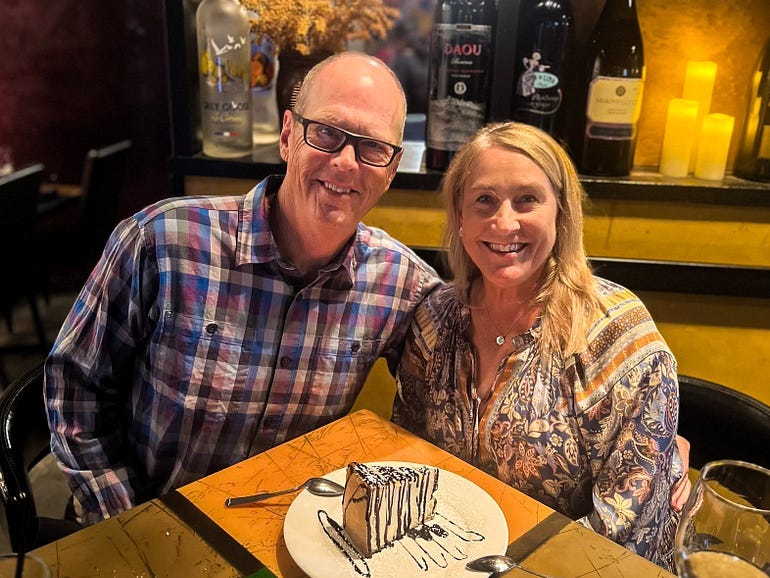
The woman you see next to me in the picture above is my wife. We celebrated our 41st wedding anniversary. That was the best and most important thing that happened in my life.
Everything else paled in comparison. My wife always supported me as I tried to become someone I thought I was supposed to be. But she often knew me better than I know myself. That’s why I keep working on myself.
Being honest with myself, no regrets
Honestly, I was a marginally successful executive. A sometimes respected businessman. A good provider until I wasn’t. Someone who did his best to measure up to the expectations of family, friends, colleagues, and a society obsessed with achievement.
I was a mediocre student, an independent thinker, a dreamer, an athlete, and often my own worst enemy. I’ve made plenty of mistakes, pursued ambitions that didn’t work out, and climbed mountains only to discover I wasn’t particularly interested in the view from the top.
People told me I lacked focus, that I was irresponsible, immature, or unwilling to follow the rules. Sometimes I believed them. Other times, I wondered whether the rules themselves were the problem.
Maybe there’s more
Now, at 65, I know I’m a late bloomer. Not because I failed to achieve success earlier in life. By conventional standards, I’ve enjoyed my share. But it took decades to understand the difference between achieving success and finding fulfillment.
In his book, Late Bloomers: The Power of Patience in a World Obsessed with Early Achievement, Rich Karlgaard challenges our obsession with early success. He argues that curiosity, resilience, compassion, and wisdom often develop through decades of experience.
Perhaps those years spent wandering, failing, and reinventing myself weren’t wasted. Maybe they were preparing me for the most meaningful chapter of my life.
Finding yourself
In Shakespeare’s Hamlet, Polonius advises his son, “To thine own self be true.” Though Polonius struggles to follow this wisdom, the message has endured for centuries. But how can we be true to ourselves if we haven’t discovered who we are?
Not knowing can be painful. We play roles, take jobs, and wear masks, pretending to be something we’re not. We can sell our souls and spend much of our lives trying to get them back.
Perhaps that’s what makes some of us late bloomers. We don’t necessarily arrive at success later than everyone else. We arrive at ourselves.
The myth of early success
We celebrate young achievers. We’re fascinated by billionaires in their twenties, entrepreneurs who build fortunes before 30, and gifted children destined for greatness. If you haven’t discovered your purpose by 30, built a career by 40, or accumulated enough wealth by 50, you may feel you’ve missed your opportunity.
I bought into that thinking. For years, I measured progress against conventional milestones. When I achieved something, I enjoyed it briefly before looking for the next challenge. I rarely asked whether the destination mattered to me.
In his 2024 essay, You Might Be a Late Bloomer, David Brooks examines people whose greatest achievements came later in life. Consider Paul Cézanne, one of history’s most influential painters.
Art institutions rejected him; the Paris Salon repeatedly refused his paintings, and even his closest friend, novelist Émile Zola, seemed to lose faith in his potential. Cézanne didn’t have his first solo exhibition until he was 56. Today, he’s recognized as a pioneer of modern art.
What the research tells us
Meaningful achievement isn’t reserved for the young. A study published in the American Economic Review: Insights found that the average founder of the fastest-growing new companies was 45 when the business began. Experience, judgment, and accumulated knowledge can be powerful advantages.
Julia Child enrolled in French cooking school in her late thirties. Colonel Sanders began building the Kentucky Fried Chicken franchise in his sixties. Grandma Moses started painting seriously in her late seventies.
Their stories remind me there’s no universal timetable for discovering our potential. I spent decades believing I needed to settle on one professional identity. Today, I’m more interested in understanding how those experiences shaped me.
Curiosity matters more than conformity
Brooks observes that late bloomers often possess qualities our education and employment systems overlook. They’re curious, independent, stubborn, and sometimes uncomfortable with authority.
I recognize those characteristics in myself. I’ve worked in several industries, built businesses, advised executives, studied philosophy and spirituality, written books, and pursued photography and painting.
My curiosity called me. I answered, channeling that energy into communicating well, writing love notes, winning the wife of my dreams, raising wonderful children, and becoming a successful executive. In my early thirties, I took a leap of faith toward self-employment, eventually spending decades as a consultant and coach.
Along the way, people told me I couldn’t focus, was irresponsible, and was immature, and that I had ADHD—a disorder. I sometimes felt ashamed when I cared too much about what others thought. I’d respond, “Hey, ADHD isn’t a disorder. It’s a freaking gift!” Not everyone agreed.
Freedom. That sums up what I’ve always wanted. The freedom to be yourself, do no harm, use your God-given talents for good, and love even people you don’t particularly like.
For years, I viewed my wandering as proof I lacked focus. I was always looking for the next mountain before finishing the one beneath my feet. But so what? That’s my nature. Why fight it, trying to fit into a wild world?
In Range: Why Generalists Triumph in a Specialized World, David Epstein explores how broad experiences help people connect ideas across different fields. Looking back, I see how business, family life, spirituality, and creativity have informed one another.
What once looked like unrelated pursuits has become knowledge I can draw upon. Perhaps curiosity is a superpower more than a problem.
The freedom to stop proving ourselves
Another quality of late bloomers is intrinsic motivation. They pursue activities because they’re meaningful, not because someone offers money, recognition, or applause.
Psychologists Edward Deci and Richard Ryan’s self-determination theory helps explain why people become more engaged when activities reflect their interests and values.
Throughout our working lives, we’re encouraged to pursue better jobs, bigger houses, impressive titles, and financial security. There’s nothing wrong with these goals. We have families to support and bills to pay. But eventually, we ask different questions.
What do I enjoy? What gives my life meaning? What would I pursue if nobody were watching or caring whether I succeeded?
Retirement, forced or chosen, brings these questions into focus. Having too much time on your hands can become a full-time job. If you can’t find contentment, joy in little things, and appreciation for a quieter life, you may find yourself chasing the wind. I’ve tried. It’s like fighting reality. Exhausting.
Today, writing, painting, photography, studying great thinkers, and spending time with family matter more than another professional accomplishment. I still enjoy mentoring people but no longer feel compelled to build another business empire.
For much of my life, I confused being productive with being purposeful. I’m learning they're different. That realization has been liberating and, occasionally, unsettling.
The wisdom of getting things wrong
Late bloomers often experience plenty of failure. I have. Some of my most valuable lessons came from experiences I wouldn’t repeat. They forced me to examine assumptions, recognize limitations, and become willing to change.
I once believed wisdom came primarily from acquiring knowledge. Today, I suspect it has just as much to do with recognizing how little we know. Humbling.
We become less interested in winning arguments and more interested in understanding people. We become more forgiving of ourselves and others. We are works in progress.
Believing that the best is still ahead
Brooks observes that some artists become more expressive as they age. After decades of learning their craft, they become willing to break the rules. Their work grows freer, more personal, and less concerned with pleasing critics.
I love that idea, having rediscovered the joy of making art later in life. Not every painting has to be beautiful, and not every story I write has to win big. I improve. The creative process becomes its own reward.
Same with life. We don’t have to spend our later years defending accomplishments, protecting reputations, or desperately trying to remain relevant. We can keep learning, exploring, changing our minds, and discovering deeper meanings.
Perhaps the greatest quality of a late bloomer isn’t persistence, curiosity, independence, or even wisdom. Maybe it’s the willingness to remain a beginner while shedding the expectations, ambitions, and identities that never belonged to us.
For most of my life, I tried to become someone I thought I was supposed to be. These days, I’m more interested in discovering who I’ve been all along.
After all, a flower doesn’t apologize for blooming later than the others. It simply blooms. We bloom. Might as well do it with a smile.
Stuck in life? Check out the Clarity Shift Method™ to find your way.