

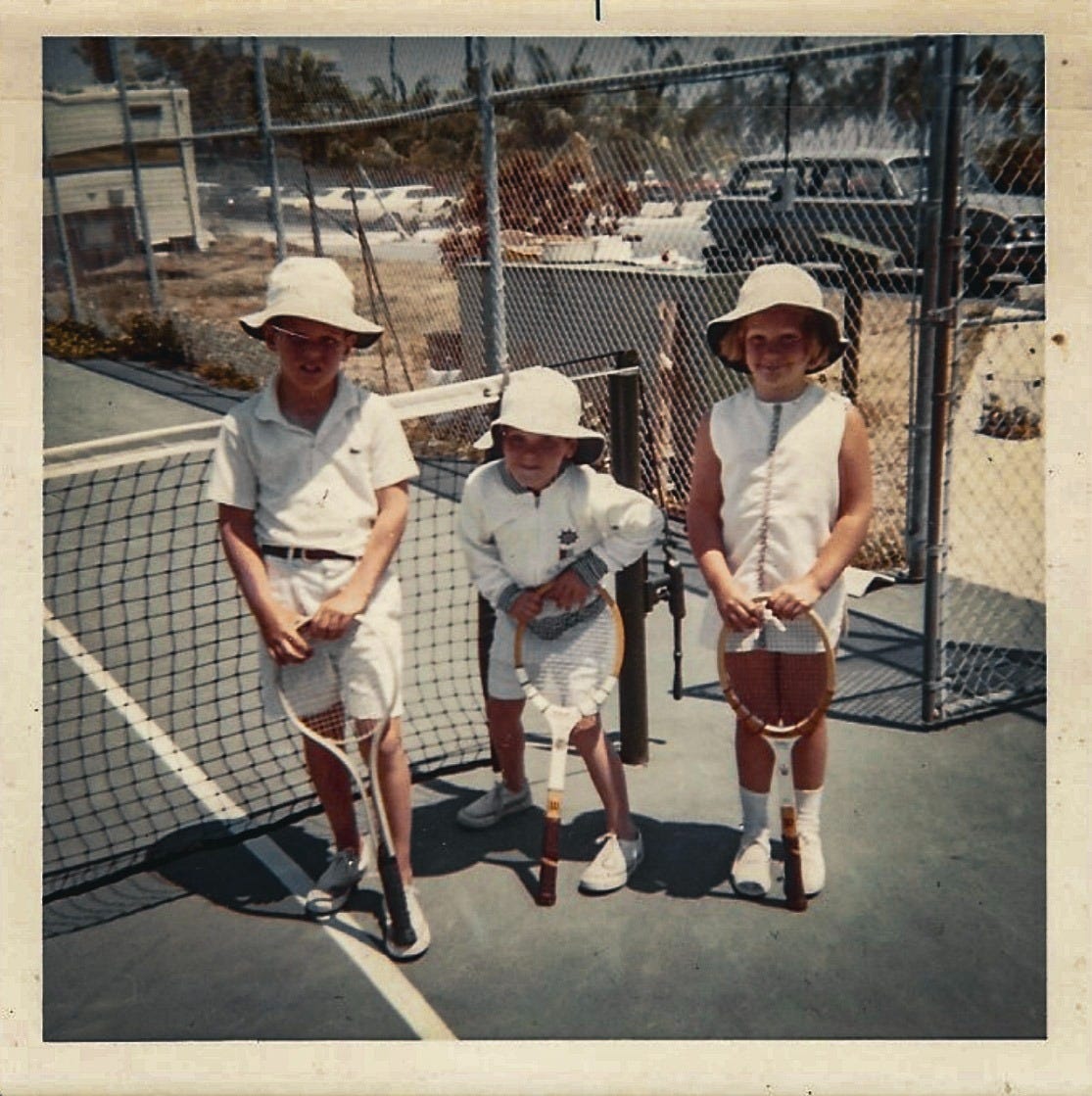
Notice the scrawny tennis kid on the left with a racket made of metal, not wood. Conversely, his younger brother and sister have wood rackets, for good reason. “Chewy,” the kid on the left, had a very bad tennis temper because he expected to win every point, game, set, and match.
He hated losing.
It was the worst thing that could happen on any given day. His attachment to winning, combined with his confounding ability to say brutally critical things to himself, often out loud so spectators and opponents could see and hear, meant a Jack Kramer tennis racket could get smashed to smithereens in a nanosecond.
Bad. Very bad. Shame, guilt, and remorse followed.
Let’s talk about self-talk
The game of life is best played when we see and talk to ourselves in healthy ways. I didn’t learn how to pull this off until well after age 50.
Before that, I used to be vicious to myself. Most people would never know it because I did a great job of acting and burying my emotions so as not to explode. Never good enough, in my own mind, I used to hold myself against ten thousand false ideals I’d invented, including becoming a world-famous tennis pro.
Of course, every time I fell short of my false ideal, I’d unleash fury on myself, but where could I run, and how could I hide? Emotional maturity was never my strength, and my inner demons ate me alive.
This morning changed that memory into something useful, and now, my article. I was standing in my kitchen with a cup of fresh medium roast, listening to the particular silence a house makes early, when I caught myself mid-conversation. Not with Janice. Not on the phone. A conversation with myself, and it went like this.
“Hey, your self-talk is completely different these days. Have you noticed that when you worry about the future, or regret something from the past, you don’t beat the crap out of yourself anymore? Like when you paint, and it sucks, you’re okay with it. You don’t need to find a flamethrower and torch yourself or your work. Nice job, dude.”
I stood there holding my coffee, struck by the question under the question, to which I already knew the answer. Who was talking? And who, exactly, was being talked to?
Welcome to the “inner game” of life
The psychological wisdom that follows is profound. It started changing my life in the early 1980s when I was a serious tennis player, chasing a serve that would hold up under pressure, and a friend handed me a paperback called The Inner Game of Tennis.
Timothy Gallwey wasn’t really writing about tennis. He was writing about the two people living inside every player’s head. He called them Self 1 and Self 2. Self 1 is the talker, the critic, the voice that narrates every mistake before it happens and grades every shot after it lands. Self 2 is the doer, the part of you that already knows how to hit the ball, the part that learned to walk and ride a bike and fall in love without a lecture from Self 1 telling it how.
That paperback rewired how I understood pressure and, eventually, how I understood myself. Once I could name the two voices, tennis got easier. But something bigger happened over the following decades. I slowly, imperfectly, trained myself to spend less time listening to the critic and more time living from the part of me Gallwey only pointed toward: an aware, accepting, higher self.
It was a form of spiritual progress in action. I lived it; I got help, read lots of books, practiced healthy self-talk, and started shedding the masks I wore to make a living as a consultant. My family and friends noticed the changes in me before I saw them in myself. I was becoming more patient, loving, humble, compassionate, and calm.
I had become willing to forgive a bad shot, a bad decade, a version of myself I no longer recognize. The kid you see in the picture above is still part of me. He’s the one who did indeed smash a pickleball paddle in half, and honestly, it felt good until I had to pony up $300 for a new one. But right after I called myself an idiot, I forgave the inner child who sometimes punishes me.
The psychology of self-talk
Long before Gallwey split the self in two, psychologists were discovering that simply talking about ourselves, out loud, to another person, could loosen something a pill never touched. Sigmund Freud and his colleague Josef Breuer called it the talking cure, a phrase coined by one of Breuer’s patients, a young woman known in the case histories as Anna O. She found that describing her symptoms in detail, tracing them back to the moment they started, made them lose their grip. Freud built a discipline on that discovery: the thought left unspoken calcifies into symptom, and the thought spoken aloud starts to lose its power over us.
Religion figured this out first. Catholic confession, at its best, isn’t about groveling. It’s about the power of penance. It’s about naming the exact place you missed, out loud, to a witness, so the miss stops living in the dark where it multiplies.
Millions of people in recovery programs worldwide do the same thing in the 5th step: “Admitted to God, to ourselves, and to another human being the exact nature of our wrongs.”
Talking about sin
The word we translate as “sin,” hamartia, comes from an ancient Greek archery term. It means to miss the mark. Not evil. Not damned. An arrow that didn’t land where the archer meant it to land. Every person in that confessional is an archer describing a miss, not a monster describing a crime.
Zen archery asks for the same humility from a different direction. In Eugen Herrigel’s Zen in the Art of Archery, the master tells his frustrated German student, “The right art is purposeless, aimless! The more obstinately you try to learn how to shoot the arrow for the sake of hitting the goal, the less you will succeed in the one and the further the other will recede.”
The lesson was never about the target
It was about the archer’s mind. A mind gripped by fear of missing will miss. A mind at peace with itself, arrow after arrow, finds the target without trying to.
That’s what shifted in my kitchen this morning. I’m not aiming less carefully at a good life. I’ve just stopped torturing the archer.
Every wisdom tradition I’ve studied points to the same architecture: two selves, or two attentions, gathered around a single soul. The Bhagavad Gita calls them the lower self and the Self with a capital S. Christian mystics call it the false self and the true self hidden in God.
Ralph Waldo Emerson, in his 1841 essay Prudence, described the degrees of proficiency in knowing the world, and the top tier belonged to what he called wise men.
“There are all degrees of proficiency in knowledge of the world. It is sufficient, to our present purpose, to indicate three. One class live to the utility of the symbol; esteeming health and wealth a final good. Another class live above this mark to the beauty of the symbol; as the poet, and artist, and the naturalist, and man of science. A third class live above the beauty of the symbol to the beauty of the thing signified; these are wise men. The first class have common sense; the second, taste; and the third, spiritual perception.”
Living in the present
For most of my life, I lived in the first class, chasing symbols, health, wealth, and approval, mistaking them for the destination. My self-talk back then was the internal auditor of that chase, always finding the shortfall.
Somewhere in the last years I moved up a level, then started reaching for a third. Not because I earned it. Because I finally understood the critical voice was never me. It was a program I built out of fear, running on a loop, mistaking itself for my identity.
The voice that spoke to me this morning over coffee, the one that said nice job, dude, wasn’t Self 1’s replacement. It was something older than Self 1, something that was there before I ever built the critic, watching the whole performance with more patience than I ever gave myself. Call it the higher self. Call it the soul, the eternal witness, the part of Mind that religion calls God speaking in the first person, the We underneath the I.
You don’t get there by trying harder to hit the mark. You get there the way Herrigel’s archer did, by loosening your grip until the arrow, the target, and the self so afraid of missing all quietly become one thing. Then you notice you’re already home, standing in your own kitchen, sipping coffee, being spoken to with more love than you ever thought to ask for.
That’s self-awareness, and it’s a beautiful thing.
Thanks for supporting my work by sharing it with your family and friends. Learn more about my coaching and the Clarity Shift Method™ here.
My particular understanding of personal development is that it is age-related.
You could not have witnessed the transformation of your internal dialogue until you were fifty. Sure, some do before, some do after, but those are outliers.
Each decade has an archetype available to you to fulfill, with specific capacities that open. Fifty is about waking up to the fact that you are not your thoughts; you have thoughts. You have an inner critic, but now the criticisms don't land and stick. Can't do this at 25.
The beauty of getting old is that, as their available archetypes make wisdom, equanimity, letting go, seeing beyond self, and being at peace with "what is" available.
People might consider getting older a rare opportunity, a blessing rather than a curse.
This really resonated with me, especially your observation that the voice in our head isn't always the truest voice within us.
I think many of us spend years believing our inner critic is simply telling the truth, when in reality it's often speaking from fear rather than wisdom.
Learning to extend ourselves the same grace we'd offer someone we love is one of life's most meaningful transformations.