

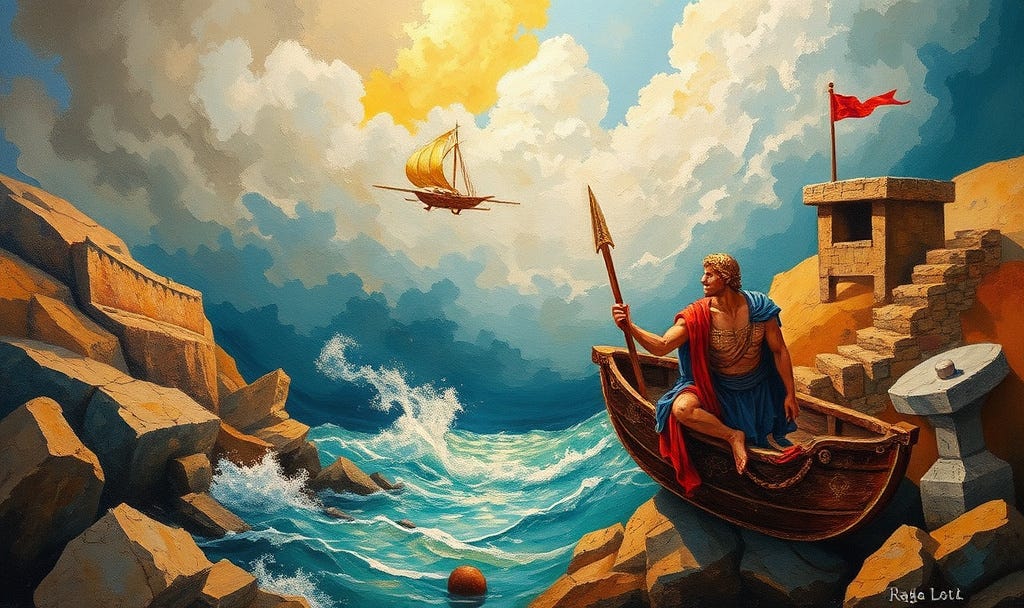
Buckle your seat belts, ladies and gentlemen, because I’m fired up. The renewed attention surrounding Christopher Nolan’s The Odyssey motivated me to return to Homer.
I began listening again to both The Iliad and The Odyssey. This time, something shifted.
Greek mythology finally made sense to me.
Perhaps I needed another four and a half decades of living before I could understand what I missed in the CliffsNotes versions of these stories. Some lessons can be taught when we are young.
Others must be lived before they can be understood
Reading Joseph Campbell’s The Hero with a Thousand Faces, along with the work of Carl Jung and other great thinkers, also changed how I approach mythology.
I no longer see these stories merely as strange tales about gods, monsters, wars, and supernatural events.
I see them as stories about us.
This realization has also inspired a new direction for The Clarity Letter. And I invite you to invite your friends and family to join us for the journey.
In the articles ahead, I want to explore the world’s greatest stories, ageless wisdom, and practical psychology to help us live with greater clarity and purpose.
Not to escape the modern world, but to understand ourselves more clearly within it.
A quick caveat
This is philosophy, not history or theology.
Zeus swallowed his pregnant wife.
Athena burst fully grown from his skull.
Prometheus stole fire from the gods.
Narcissus fell in love with his own reflection.
The Minotaur lived beneath a labyrinth.
Read literally, these stories seem impossible. They sound more like modern superhero movies than serious attempts to understand reality.
Yet they have survived for nearly 3,000 years.
Why?
Because stories can reveal truths that facts alone cannot always express.
The ancient Greeks were wrestling with the same questions we still ask:
What makes us wise?
Why do we destroy ourselves?
Where does courage come from?
Why do good people suffer?
How should we live?
Those questions never disappear.
The questions eventually find us
Many of us do not seriously consider these questions when we are young. The calls don’t start until later in life.
In our twenties and thirties, we are busy building careers, raising families, paying bills, and establishing our place in the world. We construct the scaffolding of a life without always asking what the structure is meant to hold.
Then, somewhere along the way, achievement stops being enough.
We begin asking about purpose instead of productivity.
Meaning instead of status.
Inner peace instead of the next material milestone.
This shift often arrives after we lose something, survive something, or accumulate enough years to notice how much of the noise never mattered.
The modern world has not made this search easier.
We have access to more information than any previous generation, yet many of us feel less certain about what is true, valuable, or worth pursuing.
Overwhelmed by noise, we begin looking for solid ground.
Some people turn toward faith. Others rediscover philosophy, psychology, literature, or mythology.
We begin searching beneath the surface.
Mythology was the language of meaning
The ancient Greeks used mythology to explore the invisible forces shaping human life.
The mistake we sometimes make is assuming these stories must be either literal history or meaningless fantasy.
There is another way to read them.
Myths can be understood as metaphysical stories expressed through symbols.
Metaphysics asks what lies beneath appearances. It explores reality, existence, consciousness, identity, and purpose.
It does not merely ask what something is made of.
It asks what it means.
Symbolism works the same way. Instead of asking only whether an event happened exactly as described, we ask what lasting truth the story is trying to communicate.
Sometimes a symbol is the only container large enough to hold a difficult truth.
Once we begin reading mythology through this lens, its strangest stories start making sense.
Athena and the birth of wisdom
Consider the birth of Athena.
According to the myth, Zeus learns of a prophecy that one of his children may someday overthrow him. To prevent this, he swallows his pregnant wife, Metis.
Metis represents wisdom, counsel, and intelligent foresight.
Later, Zeus develops a terrible headache. His skull is split open, and Athena emerges fully grown, wearing armor and carrying a spear.
Taken literally, the story is bizarre.
Taken symbolically, it becomes profound.
Zeus does not destroy wisdom by swallowing Metis. He internalizes it.
Athena then emerges from his head. She represents wisdom becoming conscious.
She becomes the goddess of strategic thinking, justice, learning, craftsmanship, and civilization. Unlike Ares, who represents the chaos and fury of war, Athena represents disciplined intelligence.
Even her armor has meaning.
Wisdom is not passive. It must sometimes defend truth, resist impulse, and face conflict with clarity rather than anger.
The myth stops being strange.
It becomes human.
The gods and monsters within us
The same pattern appears throughout Greek mythology.
Prometheus represents the courage to bring knowledge into the world, even at tremendous personal cost.
Icarus warns that ambition without humility can become self-destructive.
Narcissus reveals the emptiness of excessive self-absorption.
The Minotaur represents the darker instincts we hide beneath the surface of civilized life.
The labyrinth represents the confusing inner journey each of us must eventually navigate.
These are not merely stories about distant gods and imaginary monsters.
They describe forces that remain active within the human mind.
Carl Jung believed myths express universal patterns in the human psyche. He called them archetypes.
The hero.
The ruler.
The trickster.
The shadow.
The wise elder.
Cultures separated by centuries and continents created similar characters because human beings continue to struggle with the same fears, desires, temptations, and questions.
Technology evolves.
Human nature changes much more slowly.
Myths were not simply entertainment. They helped cultures pass their hardest-earned wisdom from one generation to the next.
Odysseus is trying to become worthy of home
This may be why The Odyssey continues to captivate us nearly three thousand years after it was first told.
Odysseus is not merely trying to sail home.
He is trying to become the kind of man capable of arriving there.
The dangers he encounters represent more than physical obstacles. They reflect the inner adversaries every person eventually faces.
Pride.
Temptation.
Fear.
Distraction.
Anger.
Despair.
The Sirens tempt Odysseus away from his path.
Circe transforms men into animals ruled by appetite.
The Cyclops represents brute strength without wisdom or restraint.
Calypso offers comfort and immortality, but only if Odysseus abandons his true home and purpose.
Each challenge asks the same question:
Will Odysseus remember who he is?
That may be the central challenge of every human life.
The world constantly tries to distract us, flatter us, frighten us, and convince us to exchange our deeper purpose for immediate comfort.
The journey home is the journey back to ourselves.
Why mythology will never disappear
Mythology does not vanish.
It changes costumes.
The ancient hero becomes a modern detective, soldier, athlete, entrepreneur, rebel, or superhero.
The dragon becomes addiction, illness, grief, corruption, fear, or personal failure.
The outer details change, but the inner journey remains.
As I have grown older, I have become less interested in proving whether every ancient story happened exactly as written.
I am far more interested in understanding why certain stories have survived for thousands of years.
The most useful questions may be:
What does this story reveal about human nature?
Where do I see myself within it?
What is it asking me to confront?
What is it asking me to change?
Science helps us understand how the universe works.
Mythology helps us understand how human beings experience it.
One explores the mechanics of reality.
The other explores its meaning.
We need both.
The greatest journey in The Odyssey is not the voyage across the Mediterranean.
It is the journey every one of us must make toward wisdom, clarity, and purpose.
It is the long journey home to ourselves.
Thanks for leaving a comment and restacking this article if it helped you. Learn more about me at CliffordJones.com.