

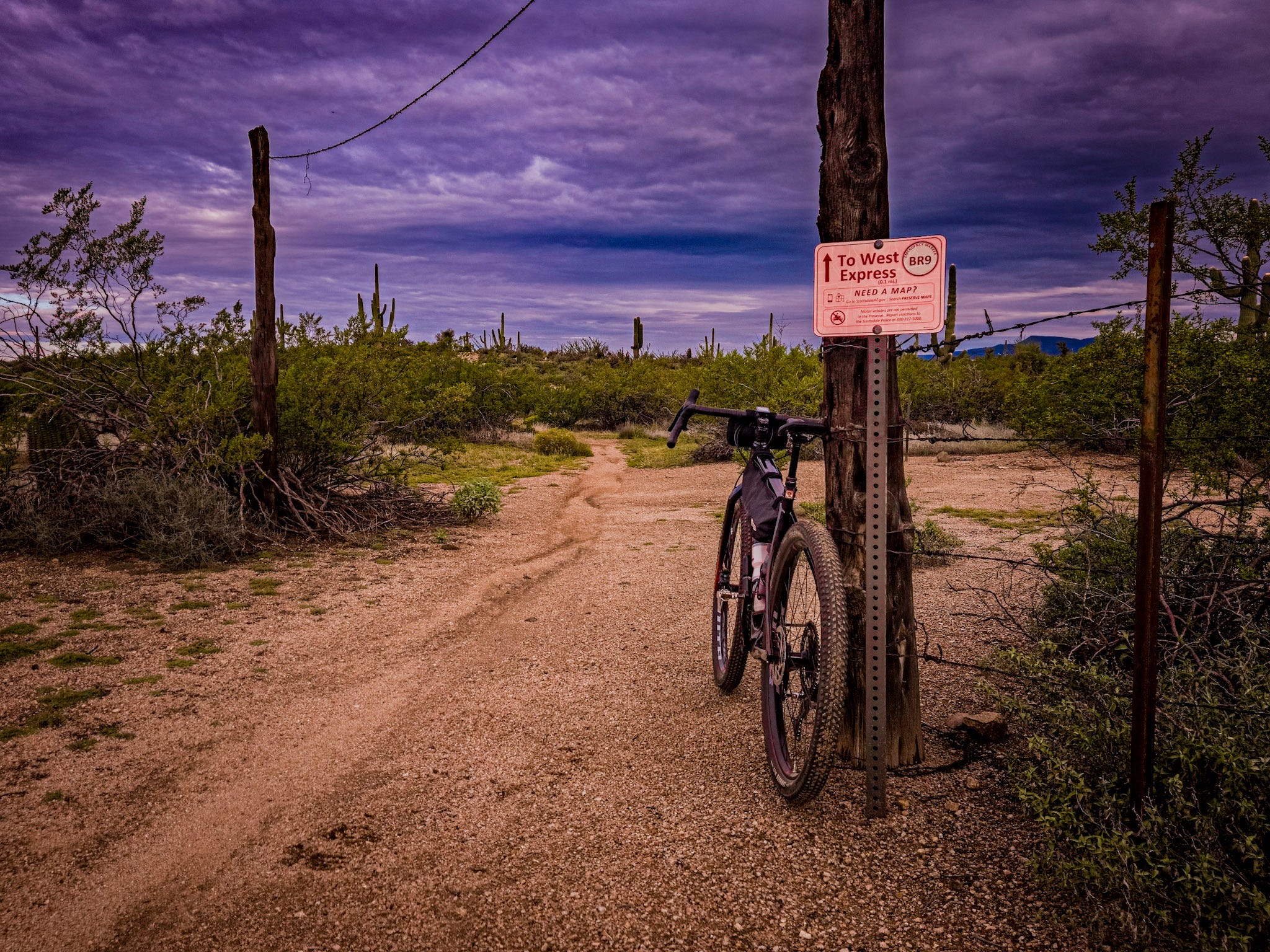
On a recent cool, clear Arizona morning, I set out on a bicycle ride a little after six. Within a few minutes of soft pedaling, I named my gravel bike Black Widow, because all of my bicycles have names. I climbed the slight grade to the gravel path, which keeps me as far from cars as possible.
It’s just over six miles to the trailhead and access to more than thirty thousand acres and over two hundred thirty miles of trails in Scottsdale’s McDowell Sonoran Preserve. It’s heaven on earth for someone like me, but getting there takes time, and part of the journey requires sharing the road with cars.
Before reaching one of the back roads leading toward the trails, I cut through a quiet private community. I pedaled uphill for almost two miles before reaching its gate. Normally, the gate is closed for security reasons. On this day, the entrance gate was wide open.
At the last second, as I approached, I decided to ride through the exit instead of around. I didn’t think much about it until I saw a delivery vehicle coming straight at me. In that instant, I braced for impact and tried to steer away from its front grille.
The driver slammed on his brakes and stopped within an inch of my right leg. It felt like slow motion. We exchanged shocked looks, and I realized I was holding my breath as I rode around him.
I raised my hand. “Dude. Sorry.”
The driver rolled down his window when I added, “That was completely my fault. I know that’s a crappy way for you to start your day. Forgive me, okay?”
What he said next reminded me of a higher power, one that is all-loving, and he said with a warm smile, “It’s all good, man. I’m glad I got the brakes in time. Have a blessed day.”
We waved goodbye, and I pedaled north, overwhelmed with relief. And gratitude. I’ve ridden these streets, back roads, trails, and small mountains on different bicycles for almost forty years. This was the closest encounter I’ve ever had with a car while riding them for many decades.
For the rest of my twenty-two-mile ride, I replayed the scene countless times. Within minutes, I was overwhelmed with tears of immense joy for being alive. I wondered again how I was still here.
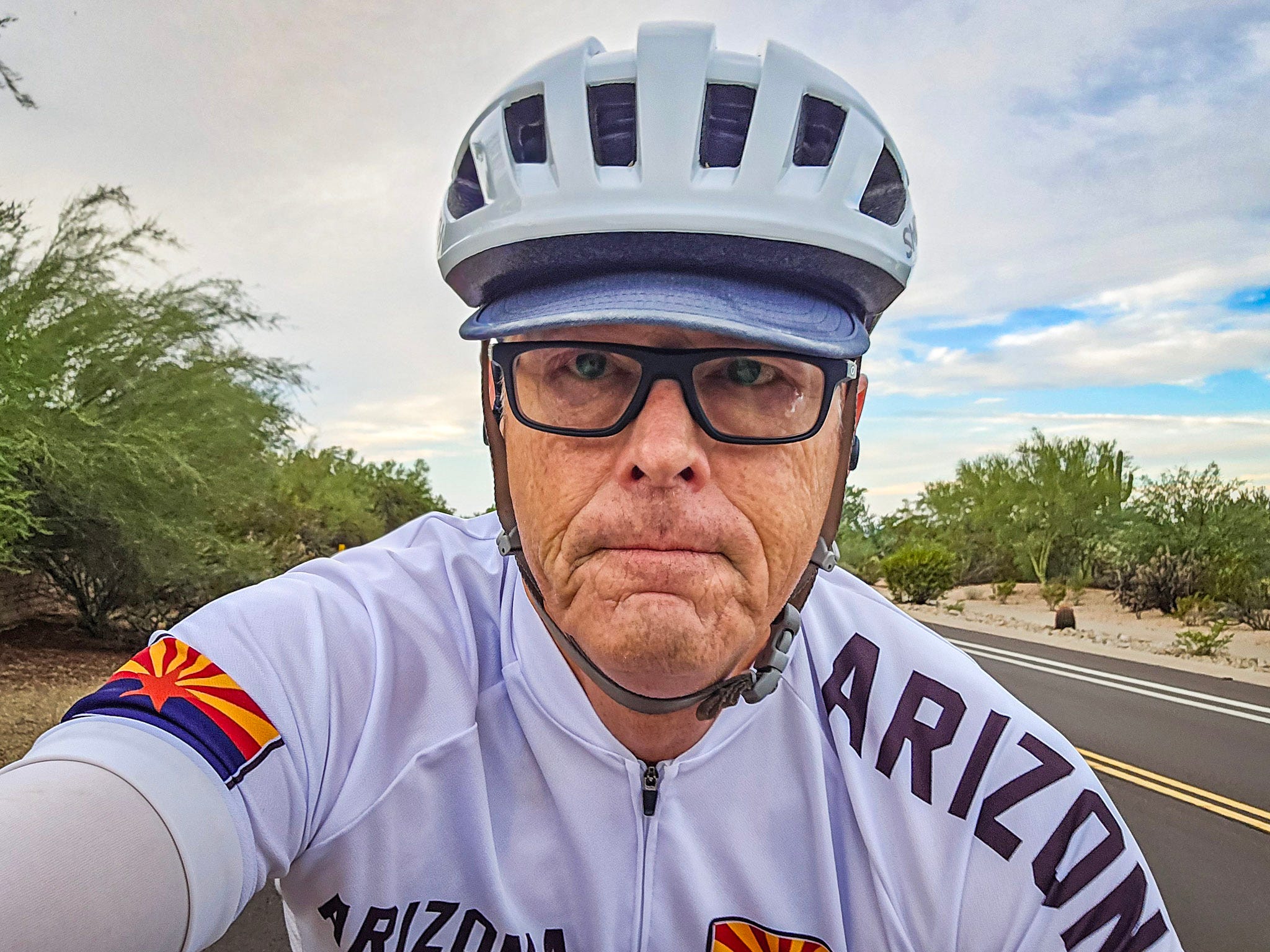
Then a shift occurred
As the tears dried in the cool desert air, a little anger began bubbling up. I noticed it because my solar plexus started heating up as if somebody had installed a ballistic missile in there. I’m happy to report I’ve done enough inner work to know not to launch those missiles anymore. They’re deadly for my karma.
You see, my body keeps score of our emotions—all of them. So does yours. My nervous system was remembering another morning more than twenty years ago when a man driving a Lexus hit me from behind while I was riding my bicycle through another private, gated community.
It was early morning, and almost nobody was on the road. I was soft-pedaling downhill at nearly thirty miles per hour when, according to three cyclists riding behind him, the driver deliberately turned his car into me.
His passenger-side mirror slammed into my left arm. Then the side of his car somehow clipped my saddle and launched me into the air. To this day, I don’t know how I kept the bicycle upright. Had I crashed at that speed, I could have been seriously injured or killed.
The adrenaline surge made me feel superhuman. I shifted into my biggest gear and hammered the pedals after him. Picture a skinny, furious cyclist in dorky shorts trying to chase down a Lexus. I was pissed, and I intended to catch him.
He made it through the gate before I could. The cyclists behind me pulled up, including a guy I knew named Corky, and one of them was already calling the police. Officers responded quickly, found the driver at the end of the street, and brought him back.
In the end, there was no ticket, citation, or arrest. The officers wrote an incident report, gave us copies, and left. I was incredulous and angry.
I stayed angry far too long. I carried a huge resentment toward that man and even took it upon myself to knock on his door one morning so we could “talk about it.”
Yeah, right.
I’m not a fighter
I’m a lover. I suck at fighting, and the only time I’ve been punched hard in the head, I saw enough stars to learn that winning friends and influencing people is generally wiser than being a smart-ass who gets beat up a lot.
The man didn’t answer his door. Instead, he called the police and taunted me from inside. I walked away because the last thing I wanted was legal trouble—or to see the inside of a jail again.
Looking back, I was being a fool. I was resentful and didn’t yet have enough tools to talk myself out of doing something stupid. What bothered me most was the injustice of it. How dare he hit me and drive away?
But life isn’t fair. Sometimes life sucks—big time. We can learn from these experiences and grow, or we can carry them around with us long after the event itself is over.
For years, I carried that one. This morning, I remembered it as if it had happened yesterday. Yet eventually I came to understand that personal growth—becoming a better human—was the real lesson.
I was one of the actors in that scene. My part was Bicycle Guy, followed quickly by Victim. Perhaps I really was a victim that morning, but I didn’t have to keep playing him for the next twenty years.
The resentment became toxic, and learning to let it go was liberating. I had plenty of other resentments to release, too, because resentment is only one kind of energy we carry in our bodies. Fear, shame, grief, anger, humiliation, and loss can all leave their fingerprints.
Resentments suck the love out of us
Our job, as I see it, is to wake up and understand how mind, body, and soul can become more aligned while we’re attending this school I call life. Man, it can be brutal down here, but it can also be unbelievably beautiful.
But my experience with resentment comes from a former need to control the uncontrollable. How egotistical of me! And selfish. Who am I to think I can control the uncontrollable, or live as the wanton judge, jury, and executioner of those who slight me?
The greater reality is the morning ride was beautiful that day. The sun rose over the desert as I realized I was still healthy enough to pedal twenty-two miles through it. I was still breathing, still learning, and still here.
Loving life, even when it's hard.
I’ve spent years shedding buckets of family, life, and self-induced trauma. Along the way, I learned an important distinction about letting go. Screw being a victim. It’s against my nature. I would rather learn to accept what happened, process what remains, and eventually transcend it.
Letting go of the toxic stuff.
Understanding trauma
Trauma can also involve what happens inside us after something overwhelming occurs—the emotional, biological, and psychological imprint that can remain long after the danger itself has passed. One book that helped me understand this was psychiatrist Bessel van der Kolk’s The Body Keeps the Score.
Published in 2014, the book helped broaden public understanding of how traumatic experiences can continue affecting the brain, body, emotions, and behavior long afterward. The mind may say, “That happened twenty years ago,” while the body responds as though it happened yesterday.
Van der Kolk spent decades working with people affected by trauma, including Vietnam veterans early in his career. His work helped me understand something I could feel on my bicycle this morning: remembering danger is not purely an intellectual experience. The nervous system can react before our thinking mind has even figured out what is happening.
I never fought in a war, even though I lived through more than I’d like to remember, especially the War on Drugs, which was moronic. But like most people who have lived long enough, I’ve had my share of experiences that left marks. Other people caused some of them. Life caused others.
And plenty were caused by me. To let go, to heal, to improve as a human, I had to own my part in all of this. Living down here in the school of life doesn’t mean pretending it doesn’t hurt. It doesn’t mean calling injustice good or suffering pleasant. It means refusing to spend the rest of our lives imprisoned by what happened yesterday.
It means learning to see the pain we experience as the fuel to shift into a higher gear of consciousness. When we know better ways to deal with life’s curveballs, we can sit, be still, and know our part: to learn to love the seeming insanity within and around us.
Accept it for what it is: a lesson from which to learn. End the arguments with reality, which are futile and life-sucking.
A few mornings ago, a delivery driver stopped one inch from my leg. He took it in stride, accepted my apology, and blessed me for the rest of the day. How does it get any more self-evident that we can learn to love all our brothers and sisters even when we are on the road delivering stuff to rich people or pedaling a gravel bicycle to the trails?
More than twenty years ago, another driver actually hit me. That old memory could have ruined my morning, but instead it reminded me how grateful I am to be here still. So I kept pedaling.
Maybe that’s what healing sometimes looks like, and maybe that’s what aging with gratitude looks like, too. We remember what happened, learn what it has to teach us, and slowly loosen our grip on the parts we no longer need to carry.
Then, if we’re lucky, we keep pedaling and realize the power of letting go and letting a higher power teach us to love.
Good whiplash opener and a great read. Thanks for posting! Keep up the great work!