

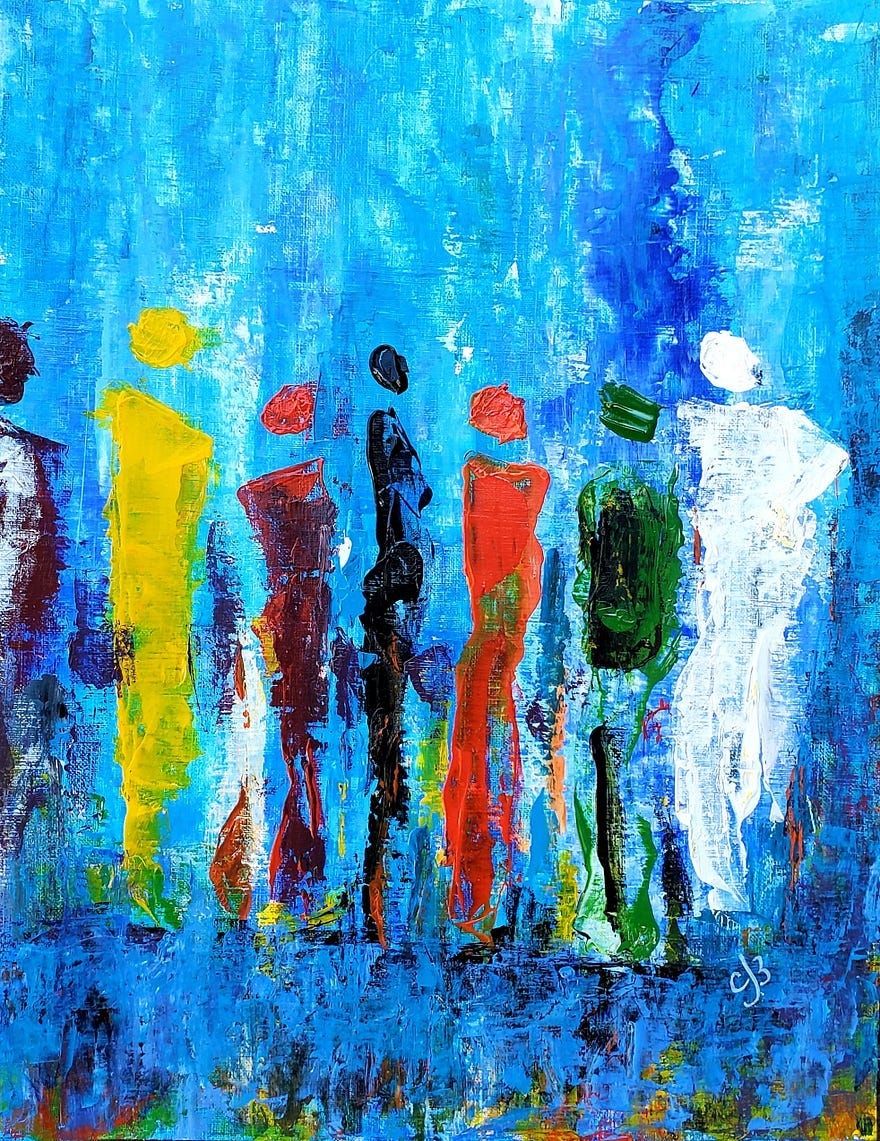
I beamed as I walked up to Leo Posillico, carrying the painting you see here. I had worked on it for hours, finally cracked some code in my mind, and couldn’t wait to show it to him.
Leo looked at the painting, then looked at me and said, “What the fuck is that?”
That was the beginning of one of the most brutal and useful art lessons I’ve ever had. Looking back, I’m grateful.
Learning without a classroom
I came to visual art late in life, mostly during the pandemic; doodling during webinars from hell revealed a hidden talent. I kept drawing, then painting, and I’ve been learning ever since. I’ve been learning mostly the way I tend to learn anything that grabs hold of me. I become obsessed with it. I watch artists teach online, read books, study paintings and photographs, ask questions, practice, screw things up, and try again.
Most importantly, I seek out local artists willing to mentor me or let me watch them work. That is one of the great benefits of being an autodidact. Nobody hands you a syllabus, so you follow your curiosity wherever it takes you. The downside of my accelerated learning approach is that nobody hands you the rulebook either.
Leo Posillico taught me that lesson.
I happen to live only a few miles from some of the best seasonal art shows in Scottsdale, Arizona. One of them is the Celebration of Fine Art, which began in 1991 after founders Tom and Ann Morrow were inspired by Laguna Beach’s art festivals. Their concept was different from a traditional gallery. It brought together about 100 juried artists and let visitors meet them, talk with them, and watch many of them create their work.
I figured, why wouldn’t a beginning artist go there and learn from people who actually know what they’re doing?
I wasn’t much of an art buyer. In fact, there wasn’t much art hanging in our house other than my own photographs, charcoal sketches, drawings, and paintings. I was becoming an artist, or at least trying like hell to.
I started approaching artists and asking questions. To my surprise, most were incredibly generous. If there weren’t a buyer nearby, many would talk about technique, brushes, color, composition, mistakes, and whatever else I was curious about. A few became mentors, and every conversation became part of my homemade art education.
Then I met Leo
Leo’s work grabbed me immediately. He painted landscapes, cityscapes, abstracts, and simplified human forms that became known as “Leo’s People.”
His colors were magnificent. The figures often had very little anatomical detail, yet somehow they moved and communicated. His people spoke to me as if to say, “Cliff, paint me. Paint me if you can.”
According to Leo Posillico’s biography and obituary, he studied at the School of Visual Arts in New York, served as an Army photography adviser and instructor in Vietnam, and worked as an art director, illustrator, photographer, and designer before becoming a full-time fine artist.
His distinctive human figures reportedly began as doodles while he talked on the telephone.
That fascinated me because I was still trying to understand what I could remove from a painting without destroying it.
So I copied him.
Not to sell or pass off a specific painting as my own. I was trying to understand his visual language. How did he simplify people that much? How did he use large areas of color? How could so few marks suggest so much?
I went back to my little hack studio at home and kept working on it. Eventually, I made this painting, and damn, I liked it.
“What makes you think you can do that?”
I carried the painting back to Celebration of Fine Art like a kid carrying his first trophy. Leo’s booth was on the opposite side of the show, so I went straight to him and waited until no customers or buyers were around.
“Leo, I want to show you something.”
I showed him the painting.
“What the fuck is that?”
I explained that I loved his work, had been studying it, and had tried to understand what he was doing. I admitted that, yes, I guess I had copied it.
Then came the second shot.
“What makes you think you can do that?”
I told him the truth. I was a new artist. I didn’t know. I thought this was how artists learned. I wasn’t trying to steal anything from him. I was trying to emulate an artist whose work I admired because I had no idea what I was doing.
I apologized and walked away carrying the same feeling I had when I was six years old and got busted for stealing six dollars from my Mother’s purse. What had begun as an instant of pride had turned into sinister humiliation.
After an hour or so, I decided I couldn’t leave it that way. I went back, apologized again, and asked what I could do to make it right.
This time his tone changed.
“Listen, it’s okay.”
His wife, Isabelle, an accomplished jewelry artist who exhibited nearby, was across the aisle. As I walked away carrying my painting, head down and feeling defeated, I remember glancing toward her. We exchanged a look, and I kept walking.
The lesson sucked, but it stuck
The following year, I mostly avoided Leo’s booth. I kept doing what I had been doing, meeting artists, asking questions, watching them work, reading books, taking online lessons, and painting.
That’s the strange beauty of being self-taught. You wander. You experiment. You follow people down rabbit holes, watch hours of demonstrations, ruin perfectly good paper and canvas, and occasionally stumble into something that changes the way you see. No professor tells you what comes next. Curiosity does that.
At a later show, I noticed Leo wasn’t there. I saw Isabelle and asked if I could tell her a quick story. I told her what had happened.
She remembered me.
Then she told me Leo had died.
Leo Posillico died on June 14, 2024, at age 79. Before writing this story, I researched more about the man I had briefly known. His obituary says he had been diagnosed years earlier with pulmonary fibrosis, a progressive disease that scars the lungs.
That changed how I remembered our encounter. Not because Leo was wrong or because I was right. We were looking at the same painting from completely different places. I was a beginner trying to learn. He was an accomplished artist who had spent decades developing a visual language that was unmistakably his.
Copying, stealing, and becoming yourself
An old line usually attributed to Picasso goes: “Good artists copy; great artists steal.” The problem is that little solid evidence shows Picasso actually said it.
The better-documented idea comes from T.S. Eliot. In his 1920 essay collection The Sacred Wood, Eliot wrote about the difference between immature artists who merely imitate and mature artists who absorb influences and transform them.
That makes much more sense to me today.
Beginning artists imitate because we don’t have our own language yet. We borrow brushstrokes, palettes, techniques, compositions, and ideas. Writers read writers. Musicians learn other people’s songs. Painters study painters.
But you can’t stay there.
Eventually, everything you borrow has to pass through your own experiences, failures, imagination, eyes, hands, and heart. That’s when it begins turning into something of your own.
I still learn online. I still read art books and study great artists. I still seek advice from local artists who know far more than I do, and I still make plenty of ugly paintings. Mostly, I practice.
Nobody is coming to certify me as an artist. No diploma is waiting at the end. You become one by doing the work, asking questions, experimenting, failing, practicing, and occasionally embarrassing yourself.
Little by little, what you’ve borrowed from everyone else starts passing through you.
Eventually, they start to look like yours.
I don’t paint like Leo Posillico today.
I suspect Leo would be happy about that.
Clifford, great story written and submitted with courage and vulnerability. Apparently, the late great Leo does not subscribe to imitation being the finest form of flattery. Ah well. he was not easily flattered in his state of health at that time. I think if you had engaged him initially and let him know what you were setting out to do adn why, it might have evoked a different response. Permission vs. Apology has never been something you tangled with so why start now? The lesson that I am taking away here is that if you wish to study under a master artist, you must do so with their permission if you have any hope of gaining their guidance. Music Artists have sued each other famously in great repetition for imitating their art with similar note sequences and rhythms, melodies, etc. Thanks for sharing.