

I’m early in retirement, even though I still do a bit of mentoring. Mostly I practice my arts: writing, photography, and painting. I can learn to love life like this. But having so much free time on hand takes work.
Life’s irony cracks me up as I look back. I helped people retire for more than a decade as a financial planner, registered investment advisor, and consultant to hundreds of people who outsourced their money management and retirement planning. The only problem was that I didn’t know a thing about retirement.
Not really.
Sure, I knew how to ask clients the discovery questions. I knew how to operate the software that spit out handsome financial plans, colorful charts, and portfolio recommendations. I understood asset allocation, inflation, risk tolerance, longevity risk, and the unpleasant possibility of outliving your money.
I knew enough to help people prepare financially for retirement. What I didn’t understand was how to live it.
You can’t learn that part from a webinar or online course.
I’m learning it now
As I approached retirement, I had a story in my mind that told me not working would be silly if I loved the work. But over the last several years, I stopped loving my work, and I let go of the business consulting work I hustled for decades. That left a void I’m still working to fill with creative projects, volunteering, and family.
I recently started Social Security, considering it’s not so secure anymore. We live a modest life, so I was open to whatever might come next. And I dove into what began calling to my heart.
Since the pandemic, I’ve become increasingly obsessed with nonfiction writing, photography, and, more recently, learning how to paint. In other words, I’m becoming an artist for the rest of my life.
That sentence would have sounded ridiculous to my younger self.
For most of my adult life, I was an athlete. Sports were my art. I also tied productivity to money. Ego. My self-image as a self-employed consultant. Work created income. Income created security. Achievement created identity.
Traditional retirement messes with that equation. Good thing I’m not hung up on traditions.
My wife and I keep saving, and our modest portfolio is providing well, and we have saved enough to believe we’ll be okay, even though neither of us knows for sure whether we will outlive our money.
Nobody does. Too many variables: markets, inflation, health, longevity, family needs, and whatever surprises life throws through the front window.
But these days, my most important title isn’t founder, consultant, author, or advisor.
It’s Pop Pop, aka Pa Pa, the grandfather.
We will soon have four grandchildren, and I’m having a blast figuring out how to become a world-class grandfather. I’m not bragging when I say this. I’m acknowledging something that took me most of my life to understand.
I have largely arrived at the life I worked so hard to create.
And now I get to learn how to live it
That can be harder than it sounds. It’s as if I own a time bank. I tell my friends that, and they chuckle because they can’t relate to what I mean: being a good steward of time instead of becoming a slob on a couch, plopped in front of an idiot box.
Too much time on your hands can become dangerous territory without curiosity, hobbies, friends, family, some semblance of faith in something larger than your own ego, and a growing sense of contentment.
I strive for sustainable contentment because happiness can be elusive. I glimpse bliss when I meditate or work on my art. Contentment seems sturdier. It means learning to live with what is while remaining curious about what might be.
That may be the retirement lesson I couldn’t have understood thirty years ago. How could I?
The job now is learning how to live a healthy, meaningful, contented life for whatever remains of it. How do I accept the things I can’t change? How do I keep learning and serving others? How do I stay physically active and mentally sharp? How do I meet new people while becoming far more selective about who gets my time?
And how do I accept the inevitable losses, disappointments, illnesses, and other difficult things every human eventually encounters?
There isn’t a training manual
There is only practice.
We age until our final breath. Where we go after that depends on what each of us believes. I happen to believe life is a gift to the soul. Sometimes I even wonder whether, at some level beyond my understanding, I chose this particular life because I needed to learn these lessons.
I can’t prove that. I find meaning in it.
Looking backward, I can see how much of my education had nothing to do with school. My wife and I raised two sons. We endured plenty of family struggles. I built businesses, lost things, rebuilt things, made mistakes, worried about money, chased success, questioned myself, and gradually discovered how little control any of us really has.
We have softened around the edges. Life did that. Marriage did that. Children did that. Age did that.
Managing wants, keeping it simple
You begin to realize how much energy humans waste fighting over things we cannot control while overlooking the person sitting beside us. Despite all the division and vitriol we see online, I increasingly notice similarities between people rather than differences.
Most people want remarkably ordinary things. They want to be safe. They want enough money. They want their children to be okay. They want someone to love. They want to matter. They want a little peace.
That describes me pretty well these days. I like living a simpler life. It’s quieter, more peaceful this way—no rat race.
I’m not chasing fame, fortune, or power. I’m living quietly in the middle, building a growing family clan, making photographs, writing stories, learning to paint, riding my bicycle, loving my wife, spoiling grandchildren, finding my way with God, and trying to become a better human before my number gets called.
I don’t know how long retirement lasts. Nobody does.
Maybe that’s the point.
Retirement requires a different kind of work
It’s the inner work that makes the greatest difference. To die in peace. To love every minute down here, even if it’s brutal.
This stage of life may be the point where we finally get to decide what truly purposeful, personal work is for.
For me, the work now is becoming.
Becoming a better grandfather. A better husband. A better artist. A better friend. A better human.
Turns out I spent decades helping people build retirement plans without understanding the most important part.
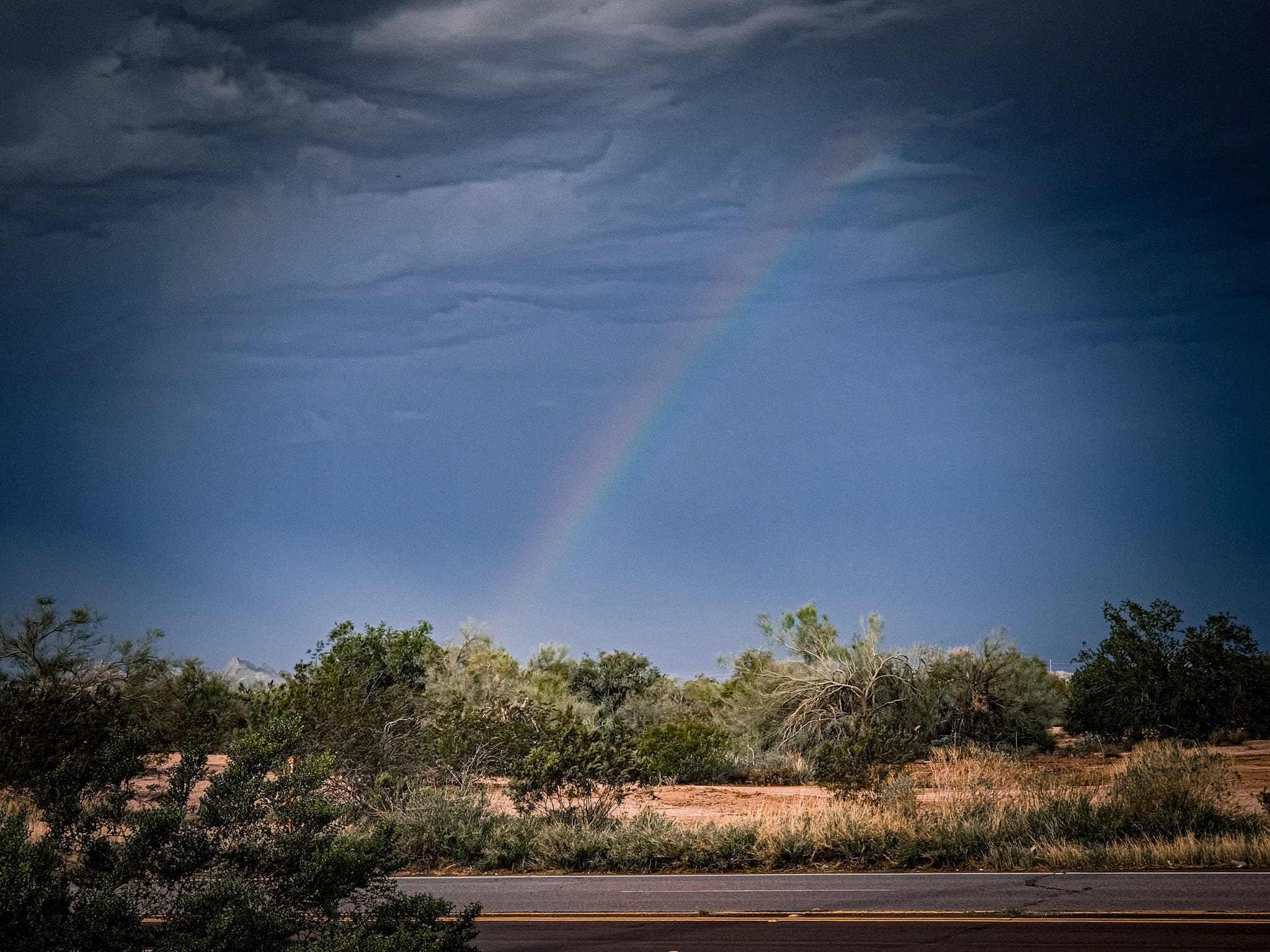
Rainbows can remind us what matters
At this stage of life, seeing an early morning rainbow while walking with your three-year-old grandson is heavenly. But eventually, you have to figure out what you’re retiring to.
You have to let go of the title, the benefits, the network, the season tickets, the parking passes, the peers at work, the conventions, the expense account, and even the dread — whatever that may have been. All those things gave structure to a life you may have spent decades building.
Then one day, much of it disappears.
What remains is you.
That’s why staying curious, staying connected, and learning something new matter. So does finding the people and activities that make you feel alive, including that ageless inner child who still wants to explore, create, laugh, play, and occasionally make a mess.
Maybe that’s what retirement is really asking of us.
Not to stop working. To be intentional about being as content and healthy as we can become.
To finally discover what makes life worth working for. Including a significant legacy for your family.
I believe there is another choice one can make when they end their career. Yes, writing, painting, reading, traveling, and sleeping in are all available. But most of these choices are self-directed and have retirement be a time for what you didn't have time for before. For some, another choice is more challenging, requires commitment, requires training and development, and focuses on healing and repairing beyond the self: that is becoming a contemporary Elder, not just a happily well-adjusted retiree.
Cliff, As a 60 year old, considering retirement in the next decade, your essay was very helpful. I need to plan for my time and energy even more than the financial piece. Thank You for stimulating my mind to be open to new things and new ideas of what it will look like. I'm excited for the next chapter and less in fear....there is so much I cannot control, and should not try! Hugh